
Quick Answer: PAR is the range of light wavelengths (400 to 700 nanometres) that plants use for photosynthesis. PPFD measures how much of that light actually lands on your canopy at a given moment, in micromoles per square metre per second (μmol/m²/s). DLI measures the total light dose your plants receive across a full day. For cannabis, target PPFD of 200 to 400 for seedlings, 400 to 600 for veg, and 800 to 1000 for flower, without CO2 supplementation.
For a long time I bought grow lights based on wattage and trusted the marketing photos of lush canopies. Then I put two different 200W lights side by side over identical clones and got noticeably different growth. Same wattage. Same wall power draw. Completely different results. The light that performed better had a PPFD rating clearly listed on the product page. The one that underperformed did not mention PPFD at all, only wattage and full spectrum coverage area.
That was the moment I stopped looking at watts and started looking at PPFD, PAR, and DLI. These three terms tell you what a light actually delivers to your plants, not what it consumes from the wall. Once you understand them, buying a grow light and setting its height stop being guesswork.
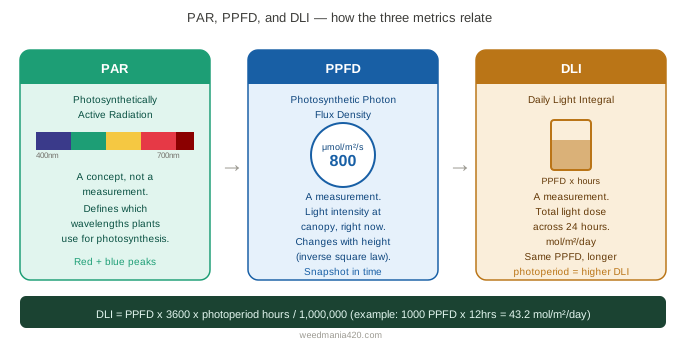
Table of Contents
PAR: The Light Your Plants Can Actually Use
PAR stands for Photosynthetically Active Radiation. PAR describes the range of light wavelengths plants use for photosynthesis, specifically the band between 400 and 700 nanometres.
This is the most important thing to understand first: PAR is not a measurement you can read off a meter. It is a concept, a definition of the usable slice of the light spectrum. P.A.R. is not a measurement like Lux or Watt, but a concept: it tells us which wavelengths matter for plant development.
Sunlight contains ultraviolet, infrared, and the visible spectrum. Only the 400 to 700nm portion, roughly the visible light spectrum from violet through red, drives photosynthesis efficiently. A light bulb can produce huge total light output measured in lumens while delivering very little usable PAR, because lumens are calibrated to human eye sensitivity, not plant photosynthetic response. This is why lumens and lux are misleading metrics for grow lights, and why Lux and Lumen can be misleading when evaluating a light’s actual growing capability.
Within the PAR band, photosynthesis happens mostly in two zones. For the vast majority of green plants, photosynthesis is mostly taking place in the red (600-700 nm) and blue (450-500 nm) part of the spectrum. This is the reason why some LED grow lights provide mostly red and blue light instead of full spectrum white light, to reduce electricity consumption for wavelengths plants use less efficiently.
When a manufacturer says a light is “full spectrum,” they mean it covers the full 400 to 700nm PAR range plus some additional wavelengths outside it. Full spectrum does not tell you the intensity of that light. That is where PPFD comes in.
PPFD: How Much Light Actually Reaches Your Canopy
PPFD stands for Photosynthetic Photon Flux Density. PPFD measures the intensity of PAR light reaching the plant canopy at a specific moment, expressed in micromoles per square metre per second (μmol/m²/s).
Think of PAR as defining which photons count, and PPFD as counting how many of those photons are landing on a specific square metre of your canopy right now. PPFD measures the amount of PAR light your plant canopy receives per second and square metre.
PPFD is the single most useful number for setting up your grow correctly because it tells you, in real terms, how much usable light energy your plants are receiving. Two lights with identical wattage can produce very different PPFD values at the same distance, depending on diode efficiency, reflector design, and spectrum composition. This is why comparing grow lights by PPFD at a fixed distance is far more meaningful than comparing wattage.
PPFD changes with distance from the light. Move a light from 24 inches to 12 inches above the canopy and PPFD roughly quadruples, following the inverse square law. This is also why PPFD readings should always specify the distance at which they were measured. A PPFD of 800 at 12 inches tells you almost nothing about what that light delivers at 24 inches.
Target PPFD by Growth Stage
These ranges assume no supplemental CO2, which covers the overwhelming majority of home grows:
Seedlings: 100 to 300 μmol/m²/s. Low PPFD (seedlings 100 to 300) pairs with cooler canopy temperatures of 72 to 76°F. Seedlings have minimal leaf area and an underdeveloped root system, so high intensity light at this stage causes more stress than benefit.
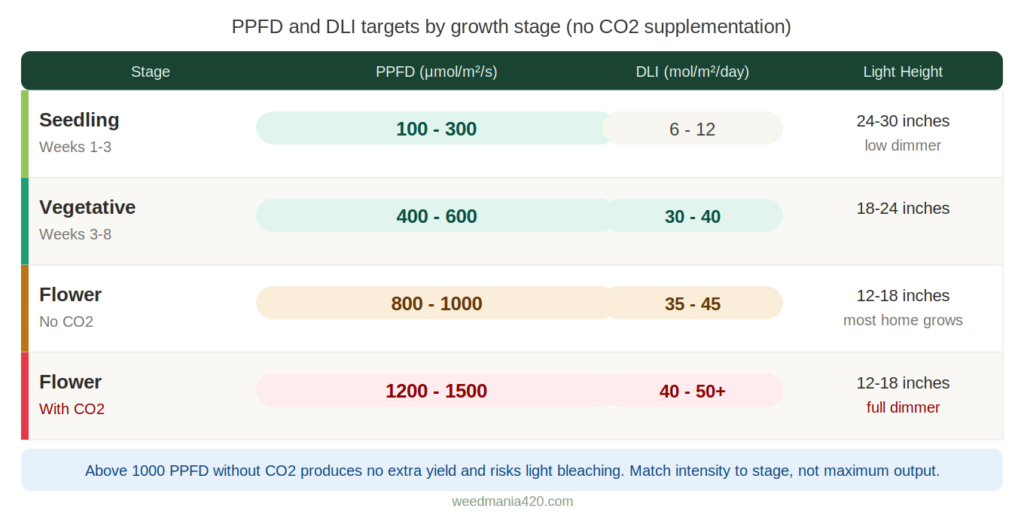
Vegetative: 400 to 600 μmol/m²/s. For cannabis vegetative growth, the recommended PPFD range is 400 to 600 μmol/m²/s, supporting robust stem growth, healthy leaf development, and strong root system establishment. During vegetative growth, plants focus on building structure rather than flowers, so they need meaningfully less light than they will during flower.
Flower without CO2: 800 to 1000 μmol/m²/s. The flowering stage is the period with the highest light requirements in the cannabis growth cycle, with PPFD targets between 800 and 1000 μmol/m²/s without supplemental CO2. This higher requirement reflects the energy demand of flower and resin production.
Flower with CO2 supplementation: up to 1200 to 1500 μmol/m²/s. Cannabis has an increasing rate of photosynthesis up to a PPFD of 1500 μmol/m²/s when CO2 is supplemented, but in commercial facilities and big grow spaces, CO2 supplementation is needed to achieve these values. For the vast majority of home growers without CO2 injection, pushing PPFD above 1000 produces no additional benefit and risks light bleaching.
Excessive PPFD may lead to unnecessary energy consumption increases, while insufficient PPFD will cause plant stretching and thin stems. Both extremes carry real costs, which is why matching PPFD to growth stage rather than maximising it at all times is the correct approach.
DLI: The Daily Light Dose
DLI stands for Daily Light Integral. While PPFD measures intensity at a given moment, DLI tells you how much total light your plants receive in a full day, combining both the light’s strength and the duration it is on. DLI is measured in mol/m²/day.
DLI is what closes the loop between PPFD and your light schedule. A light running at moderate PPFD for 18 hours can deliver the same total daily dose as a brighter light running for 12 hours. Both the intensity of the light (measured in µmol/m²/s) and the duration of exposure (hours per day) determine the DLI.
How to Calculate DLI
The formula converts PPFD and photoperiod hours into a daily total. If your grow light delivers 600 µmol/m²/s for 18 hours a day, that is roughly 38 mol/m²/day, a sweet spot for the vegetative stage of most cannabis strains.
Here is the full worked example: PPFD of 1000 μmol/m²/s for 12 hours a day. One hour has 3600 seconds, so 1000 μmol/m²/s multiplied by 3600 seconds per hour multiplied by 12 hours, then divided by 1,000,000 to convert micromoles into moles, gives you roughly 43.2 mol/m²/day, which is optimum for the flowering stage.
Target DLI by Growth Stage
DLI represents the total amount of photosynthetically active light a plant receives each day, and aiming for 20 to 40 mol/m²/day is optimal for cannabis growth overall, with specifics by stage as follows:
- Seedling: 6 to 12 mol/m²/day
- Vegetative: 30 to 40 mol/m²/day
- Flowering: 35 to 45 mol/m²/day
An increase in DLI means an increase in flower yield, making it a genuinely important measurement for cannabis growing, not just an academic figure.
Why DLI Matters Even When PPFD Looks Right
This is the part that catches out growers who think they have already done their homework. You can have reasonable PPFD and still have an excessively high DLI if you run a long photoperiod such as 20/4 or 18/6. The plant does not read your light’s marketing material. The plant experiences the total photons it receives across the day.
The biggest trap in 2026-era LED indoor growing does not look like a disaster. It looks like nice numbers in a light meter app, even plants, seemingly healthy colour, and then suddenly leaf curl, top fading, deficiencies despite feeding, swollen tops with weak aroma, or foxtailing where flowers start building new towers instead of finishing evenly. Very often the cause is one thinking error: looking at PPFD and ignoring DLI entirely.
The practical implication: if you run an 18/6 photoperiod with a light delivering 700 PPFD, your DLI works out close to 45 mol/m²/day, on the high end even for flower. If that same light intensity were used on a 12/12 schedule, DLI drops to roughly 30, comfortably mid-range. The light has not changed. The schedule has. This is exactly why two growers with what looks like an identical light setup can get different results, and why dialling in light height and intensity has to be considered alongside your chosen photoperiod from our grow light timer guide.
How to Measure PPFD in Your Tent
You do not need a professional lab to measure PPFD. A consumer-grade PAR meter or quadratic PAR sensor app paired with a basic light sensor gives readings accurate enough for home growing decisions. Position the sensor at canopy height, facing directly up toward the light, and take readings at multiple points across the canopy: centre, and each corner if your tent has multiple plants.
Readings will vary across the canopy, often significantly. A single LED panel produces its highest PPFD directly beneath the centre of the fixture, with intensity dropping toward the edges. This is the main reason multi-bar LED designs have become standard: they spread PPFD more evenly across a wider footprint than older single-COB designs.
If you do not have a PAR meter, manufacturer PPFD maps (often included in product listings showing a grid of PPFD values across a given footprint at a specific height) are the next best resource. Cross-reference the map against your tent size and intended hanging height from our grow light hanging guide.
Adjusting Light Height Using PPFD
Once you know your target PPFD for the current growth stage, height adjustment becomes a measurement exercise rather than a guess.
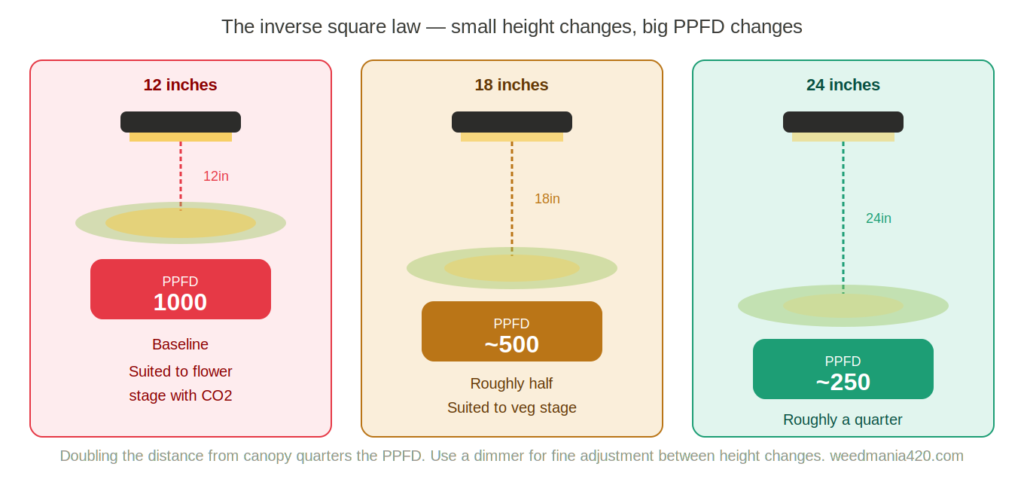
If your light produces too much PPFD at your current height for the growth stage, raise it. PPFD follows the inverse square law, so even small height changes produce meaningful intensity shifts. Moving from 12 inches to 18 inches above canopy roughly halves PPFD; moving from 12 to 24 inches roughly quarters it.
If PPFD is too low for the stage, lower the light, or increase the dimmer setting if your light has one. Most modern LED panels include a dimmer, which is often a more practical adjustment than constantly repositioning the light, particularly during the rapid height changes of veg.
The combination of dimmer control and rope ratchet hangers gives you two independent variables to manage PPFD: intensity via the dimmer, and distance via height. Adjusting both together lets you maintain target PPFD even as your canopy grows several inches between checks.
Spectrum Still Matters Alongside PPFD
PPFD tells you light quantity. It does not tell you light quality, and the two are not interchangeable. While PPFD quantifies light quantity, the grow light spectrum affects terpene profiles, and adjusting spectrum during flowering can meaningfully improve potency and aroma.
Two lights delivering identical PPFD can produce different results if their spectral composition differs significantly, particularly in the red and far-red wavelengths that influence flowering response and terpene expression. This is why the terpene profile of your harvest depends on more than just nutrients and curing. Light spectrum during the final weeks of flower is a real, measurable input into the terpene outcome.
Do not assume that hitting the right PPFD number with any light produces identical results to hitting that same PPFD with a different light. PPFD gets you in the right intensity range. Spectrum quality is the variable that separates a good light from a great one at that same intensity.
Quick Reference Table
| Stage | PPFD (no CO2) | DLI Target | Light Height Guidance |
| Seedling | 100-300 μmol/m²/s | 6-12 mol/m²/day | 24-30 inches, low dimmer |
| Vegetative | 400-600 μmol/m²/s | 30-40 mol/m²/day | 18-24 inches |
| Flower (no CO2) | 800-1000 μmol/m²/s | 35-45 mol/m²/day | 12-18 inches |
| Flower (with CO2) | 1200-1500 μmol/m²/s | 40-50+ mol/m²/day | 12-18 inches, full dimmer |
Pair these targets with the temperature guidance from general targets by PPFD range: low PPFD (seedlings 100 to 300) suits 72 to 76°F, moderate PPFD (veg 300 to 600) suits 75 to 80°F, and high PPFD (flower 700 to 1000) suits 78 to 82°F. Higher light intensity generates more heat at the canopy, so temperature targets rise alongside PPFD targets. Manage this with your VPD controller and reference the VPD chart to keep leaf temperature and humidity aligned with your light intensity at each stage.
FAQ
Do I need a PAR meter to grow good cannabis? No, but it removes a significant amount of guesswork. Many growers achieve excellent results using manufacturer PPFD maps and standard height guidelines without ever owning a meter. A budget PAR meter or PPFD sensor app costs relatively little and pays for itself quickly in better dialled-in lighting across multiple grows.
Why do two lights with the same wattage produce different PPFD? Diode efficiency, reflector and lens design, and spectrum composition all affect how many usable photons reach the canopy per watt consumed. Wattage measures electrical input. PPFD measures photosynthetic output. The relationship between the two varies significantly between manufacturers and models.
Is higher PPFD always better? No. Excessive PPFD relative to growth stage causes light stress, bleaching, and wasted electricity without yield benefit. PPFD should match growth stage and, for most home growers without CO2 supplementation, has a practical ceiling around 1000 μmol/m²/s in flower.
How does DLI affect autoflowers differently from photoperiod strains? DLI targets are driven by growth stage, not by autoflower versus photoperiod classification. An autoflower in its vegetative phase needs the same 30 to 40 mol/m²/day as a photoperiod plant in veg. The difference is timeline: autoflowers move through these stages faster, so DLI targets shift more quickly across a shorter overall grow.
Can I use PPFD targets with any grow light type? Yes. PPFD, PAR, and DLI are universal measurements that apply to LED, HPS, CMH, and any other grow light technology. The targets in this guide are not LED-specific. What differs between light types is how efficiently they convert electrical input into PPFD output, which affects running costs more than it affects the targets themselves.