
Quick Answer: The best soil for growing cannabis is Fox Farm Ocean Forest for established photoperiod plants, Fox Farm Happy Frog for seedlings and autoflowers, and BioBizz Light Mix for growers who want full feeding control. All three are pH-adjusted, well-draining, and trusted across thousands of real-world grows.
Now, let’s get into more detail.
Soil is the most consequential decision you make before a single seed goes in the ground. Get it right and your plants grow vigorously from week one, roots spreading easily through well-aerated, nutrition-rich medium. Get it wrong and no amount of good lighting, careful watering, or premium nutrients will save you.
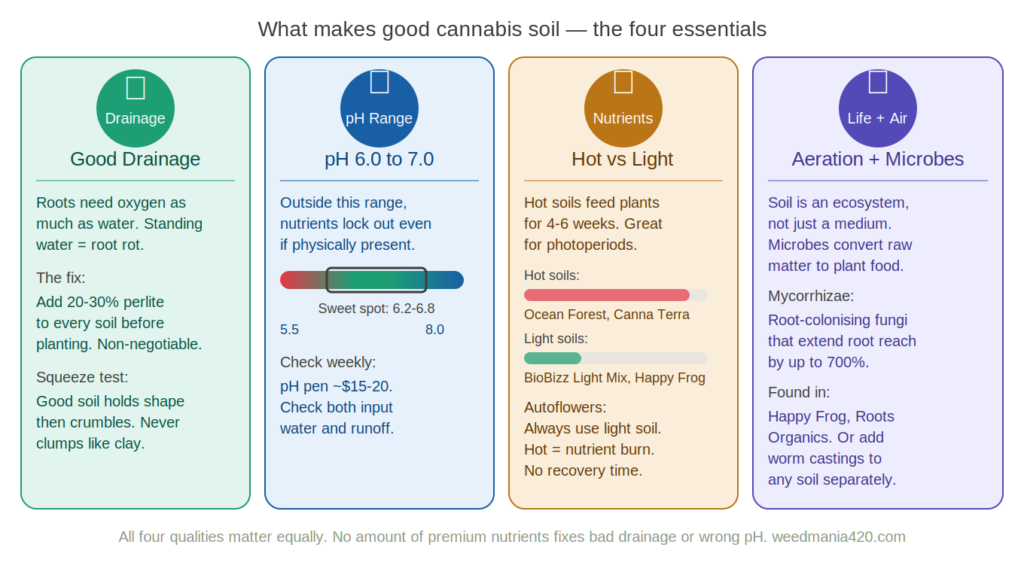
Cannabis is not a complicated plant when it comes to soil. It needs four things from its growing medium: good drainage so roots never sit in standing water, adequate aeration so oxygen reaches the root zone, a pH range of 6.0 to 7.0 so nutrients remain chemically available, and enough organic matter to support a healthy microbial population. The soils on this list deliver all four consistently across indoor and outdoor grows.
Disclosure: This post contains affiliate links. Purchases made through them may earn us a small commission at no extra cost to you. We only recommend products we have genuinely researched and believe in.
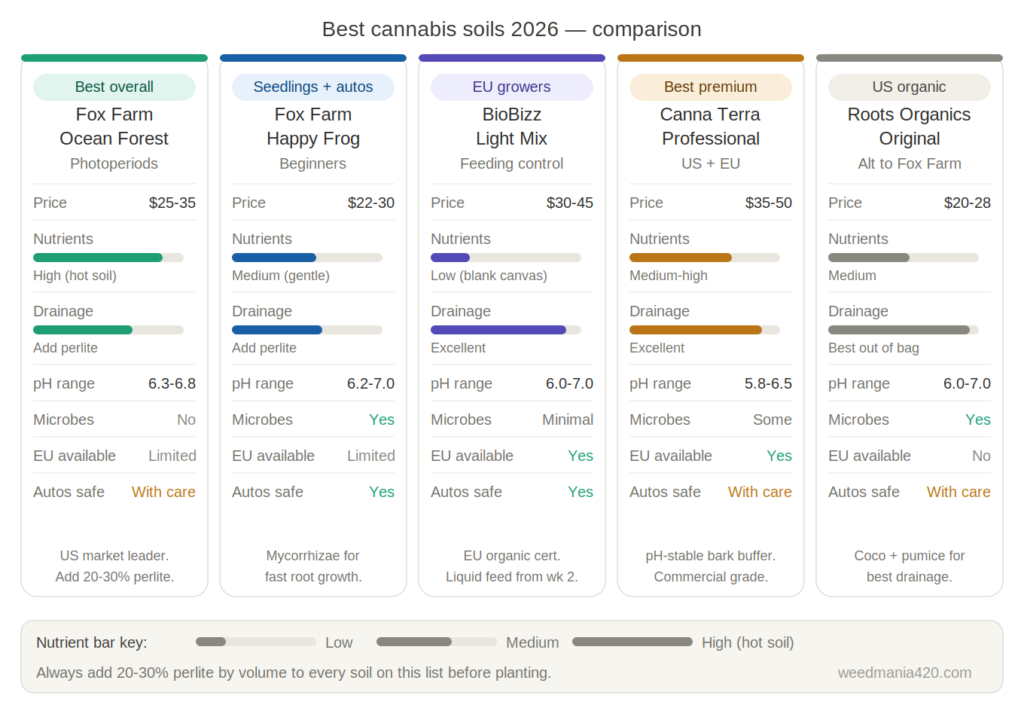
Table of Contents
What Makes a Good Cannabis Soil?
Texture and Structure
The best cannabis soils have a light, fluffy texture that crumbles easily in your hand without compacting. When you squeeze a handful, it should hold its shape briefly then fall apart, not clump like clay or run through your fingers like pure sand. This texture allows roots to penetrate easily, water to move through at the right pace, and oxygen to remain present throughout the medium.
Loam is the technical ideal: a blend of sand, silt, and clay that brings the drainage of sand, the structure of silt, and the nutrient retention of clay together in one medium. Most quality cannabis potting soils approximate this balance with organic amendments.
Drainage and Aeration
Cannabis roots are remarkably sensitive to overwatering, and most overwatering problems are actually drainage problems in disguise. A soil that holds water too long suffocates roots by displacing the oxygen in the pore spaces.
Perlite is the standard fix. Most experienced growers add 20 to 30% extra perlite by volume to any bagged soil, regardless of brand.
pH Range
Cannabis absorbs nutrients through its root system via chemical processes that only work within a specific pH window. In soil, that range is 6.0 to 7.0, with 6.2 to 6.8 being the sweet spot. Outside that range, certain nutrients become chemically locked out even if they are physically present in the soil.
Most quality cannabis soils are pH-adjusted before bagging, but this does not mean the pH stays stable across the full grow. Check your runoff pH every few weeks.
Nutrient Content: Hot vs Light
Soil nutrients come pre-loaded in the bag at different concentrations, and this matters enormously for different grow styles and plant types. Hot soils like Fox Farm Ocean Forest are rich in immediately available nutrients and are excellent for established plants.
However, hot soils are too intense for seedlings and most autoflowers, which can suffer nutrient burn during their first few weeks.
Conversely, light soils, like BioBizz Light Mix or Fox Farm Happy Frog carry fewer pre-loaded nutrients, giving you more control over feeding from the start. They are more forgiving for beginners and strongly preferred for autoflowers, which are highly sensitive to excess nutrients during their compressed lifecycle.
The Best Cannabis Soils in 2026
1. Fox Farm Ocean Forest — Best Overall for Photoperiod Plants
Price: ~$25-35 (1.5 cu ft bag) | Type: Amended potting soil | Best for: Photoperiod plants, mid-to-late veg, experienced beginners
Fox Farm Ocean Forest is the most widely used cannabis potting soil in North America, and its track record across hundreds of thousands of grows earns that position. The light and fluffy texture makes it perfect for cannabis roots to spread easily, and the pH balance of 6.3 to 6.8 ensures nutrients remain available without constant correction.
The ingredient list reads like a premium organic fertilizer: earthworm castings, bat guano, crab meal, fish emulsion, and kelp meal. These slow-release organic inputs provide a sustained nutritional foundation that carries photoperiod plants through 4 to 6 weeks of vegetative growth without any added liquid nutrients.
The key caveat with Ocean Forest is that its elevated nutrient concentration that makes it superb for established plants can cause nutrient burn in seedlings and autoflowers.
The most widely used and community-tested approach is to start seedlings in Fox Farm Happy Frog or a similar lighter mix for the first 10 to 14 days, then transplant into Ocean Forest for the main grow. A 50/50 blend of Happy Frog and Ocean Forest with 20 to 30% added perlite is the most common setup among experienced growers and reliably avoids the seedling burn issue entirely.
Add perlite before planting regardless of which approach you take. Ocean Forest straight from the bag holds slightly more water than optimal for indoor growing, and the extra perlite improves drainage and reduces compaction over time.
Best for: Photoperiod growers who want a proven, nutrient-rich foundation and do not mind managing the hot-start by using a lighter seedling medium first.
Pros:
- Exceptional track record across a huge community of cannabis growers
- Rich organic ingredient list supports growth with minimal early feeding
- pH-adjusted to the correct range out of the bag
- Widely available online and in garden centres across the US
Cons:
- Too nutrient-rich for seedlings and most autoflowers directly
- Occasional reports of fungus gnats in bags — inspect before use
- Needs added perlite for optimal indoor drainage
👉 Check current price on Amazon.
2. Fox Farm Happy Frog — Best for Seedlings and Autoflowers
Price: ~$22-30 (2 cu ft bag) | Type: Amended potting soil | Best for: Seedlings, autoflowers, beginner growers
Where Ocean Forest is the main grow powerhouse, Happy Frog is the seedling specialist. It carries a gentler nutrient profile than Ocean Forest and is enriched with beneficial microbes and mycorrhizae which improve nutrient uptake and root development.
The mycorrhizal addition is genuinely valuable. These fungi form a symbiotic relationship with cannabis roots, extending the effective root surface area and helping plants access phosphorus and other nutrients that would otherwise require higher concentrations in the soil. The result in practice is faster, more vigorous early growth compared to non-inoculated soils.
Happy Frog works as a standalone medium for autoflowers through their full lifecycle when combined with 20 to 30% perlite, which is strongly recommended. For photoperiod grows, the most effective approach is to use Happy Frog for seedlings and early veg, then transplant into Ocean Forest at 10 to 14 days for the nutrient-rich main grow.
Best for: Autoflower growers, seedling stages, and anyone who wants a forgiving, microbe-rich soil that reduces the risk of early nutrient burn.
Pros:
- Gentler nutrient profile than Ocean Forest thus less likely to burn seedlings
- Mycorrhizae and beneficial microbes support strong root development
- Works well as a standalone autoflower medium
- Reliable and widely available at the same retailers as Ocean Forest
Cons:
- Less nutrient-dense than Ocean Forest. Photoperiod plants will need liquid feeding sooner
- Tends to hold slightly more water than ideal without added perlite
👉 Check current price on Amazon.
3. BioBizz Light Mix — Best for European Growers and Feeding Control
Price: ~$30-45 (50L bag) | Type: Lightly amended organic potting soil | Best for: European growers, growers who prefer liquid feeding, autoflowers
BioBizz Light Mix is the go-to cannabis soil across the Netherlands, Germany, Spain, and the wider European growing community, and its reputation has crossed over to serious organic growers in the US who prefer full control over their feeding programme.
The low pre-loaded nutrient content is the defining feature. Where Ocean Forest loads up on slow-release inputs that feed the plant for weeks, Light Mix provides a gentle foundation of peat, perlite, and a small amount of worm castings that is deliberately lean. This means you introduce your first liquid nutrients earlier at around week 2 to 3 but you have precise control over exactly what the plant receives from day one.
For European growers, BioBizz Light Mix pairs naturally with the BioBizz organic nutrient range (Bio-Grow, Bio-Bloom, Top-Max), creating a fully organic soil-to-nutrient system that is widely available across Europe. It also complies with EU organic standards in a way that some US-formulated soils do not.
The open, airy texture makes it one of the best base soils for autoflowers in particular. It’s light enough that sensitive roots are never stressed, with enough organic matter to support microbial life.
Best for: Growers who want precise feeding control from the start, autoflower specialists, and anyone following an organic liquid feeding programme.
Pros:
- Light, airy structure almost impossible to overwater
- Widely available across Europe (Germany, Netherlands, UK, Spain)
- Ideal blank canvas for custom liquid feeding schedules
- Full organic certification
Cons:
- Requires liquid nutrients from week 2 to 3, thus not a set-and-forget option
- Less commonly available in the US than Fox Farm products
- Peat-based, which raises sustainability questions
4. Canna Terra Professional — Best Premium All-Round Soil
Price: ~$35-50 (50L bag) | Type: Premium amended potting soil | Best for: Growers wanting maximum yield potential, both sides of the Atlantic
Canna Terra Professional is the premium end of the cannabis soil market, used extensively by commercial growers and home cultivators who want the best possible conditions without building a custom super soil from scratch. It is available in both the US and Europe, making it one of the few brands with genuine global reach in the cannabis growing community.
The formulation combines a high-quality peat base with tree bark particles, perlite, and a nutrient load that sits between BioBizz Light Mix and Fox Farm Ocean Forest. Thus rich enough to carry plants through 2 to 3 weeks without feeding, but not so hot that seedlings are at risk.
The pH stability of Canna Terra Professional is particularly notable.
The bark particles act as a pH buffer, gradually releasing compounds that counteract both acidification and alkalisation over time. In practice, this means runoff pH stays more stable over a longer grow cycle compared to most competing soils, reducing the frequency of pH corrections.
Canna also produces specific nutrient lines (Canna Terra Vega and Flora) designed to work synergistically with this soil, though it performs well with any quality nutrient system.
Best for: Growers who want a step up from Fox Farm without building their own mix, and anyone who wants a premium single-brand soil and nutrient system.
Pros:
- Premium formulation used in commercial cannabis operations
- Excellent pH stability from bark-based buffering
- Available in both US and European markets
- Pairs well with Canna’s own nutrient line for a complete system
Cons:
- More expensive than Fox Farm or BioBizz options
- Slightly harder to find in the US than UK and Europe
5. Roots Organics Original — Best US Organic Option
Price: ~$20-28 (1.5 cu ft bag) | Type: Amended organic potting soil | Best for: US organic growers, outdoor and indoor photoperiods
Roots Organics Original is the strongest American alternative to Fox Farm in the organic soil category. It’s an underrated option that the community consistently recommends for those who want something different. It is lighter and drains more freely straight from the bag because it’s genuinely fluffy without the extra perlite that Ocean Forest typically requires.
The ingredient list is impressive for the price: composted forest material, coco fibre, perlite, pumice, worm castings, bat guano, fish and kelp meals, and mycorrhizae. The coco fibre addition gives it better water management than pure peat-based soils, and the pumice improves long-term aeration without the synthetic look of perlite.
Dense, quality flowers consistently come from this soil when combined with quality liquid feeding from week 3 onward. The microbe population and organic inputs create a living soil environment that is arguably more balanced than Ocean Forest for indoor growing due to its superior drainage characteristics.
Best for: US growers looking for an organic alternative to Fox Farm with better out-of-the-bag drainage and a more balanced nutrient load.
Pros:
- Lighter and better-draining than Ocean Forest without extra perlite
- Rich organic input list including coco fibre and pumice
- Mycorrhizae included for strong root development
- More affordable than Canna Terra Professional
Cons:
- Less widely available than Fox Farm
- Nutrient load still too high for autoflower seedlings directly
Quick Comparison Table
| Soil | Price (approx) | Nutrient Level | Best For | Available |
| Fox Farm Ocean Forest | $25-35 | High | Photoperiods | US widely |
| Fox Farm Happy Frog | $22-30 | Medium | Seedlings, autos | US widely |
| BioBizz Light Mix | $30-45 | Low | EU growers, feeding control | Global |
| Canna Terra Professional | $35-50 | Medium-high | Premium grows, US + EU | Global |
| Roots Organics Original | $20-28 | Medium | US organic growers | US online |
How Much Perlite Should You Add?
Add 20 to 30% perlite by volume to any bagged cannabis soil before planting. This is one of the most consistent recommendations across the growing community and applies to every soil on this list.
Perlite improves drainage, maintains aeration, and reduces the risk of overwatering, which remains the leading cause of failed first grows.
For a 5 gallon fabric pot, that means roughly 1 to 1.5 gallons of perlite mixed into the soil before it goes in the pot. The finished mix should look visibly lighter and airier than the soil alone.
Which Soil for Autoflowers?
Autoflowers are more sensitive to nutrient-rich soils than photoperiod strains due to their compressed lifecycle. Their small size and rapid development mean they absorb nutrients faster relative to their size, making hot soils a real risk during the first two to three weeks.
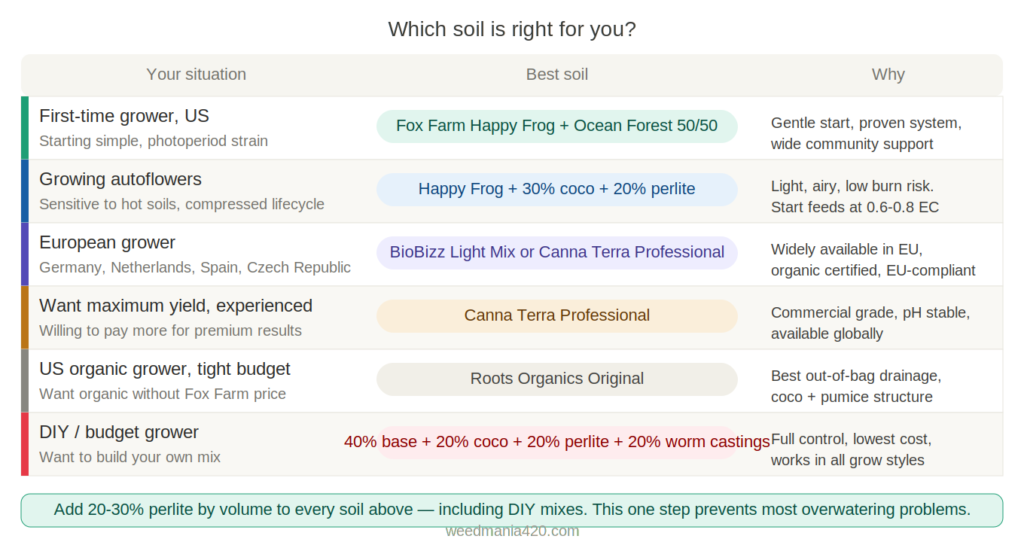
For autoflowers, use a lighter blend: 50% light base soil (Happy Frog or BioBizz Light Mix), 30% pre-buffered coco coir, and 20% perlite. Irrigate at a pH of around 6.2 and start liquid feeds very gently — around 0.6 to 0.8 EC — once the first true leaves appear.
Ocean Forest works for autoflowers but requires extra care. Keep it at half the pot depth and use a lighter mix for the top third where seedling roots first establish. See our Best Nutrients for Autoflowering Cannabis guide for the complete feeding schedule once roots reach the richer layer.
What About DIY Soil Mixes?
Experienced growers often build custom mixes rather than buying pre-amended soils. The most reliable DIY baseline is a simple four-ingredient mix: 40% quality base soil, 20% coco coir, 20% perlite, and 20% worm castings.
This creates a well-draining, aerated medium with gentle organic nutrition that suits both photoperiods and autoflowers when combined with liquid nutrients.
For a more advanced water-only approach, super soil builds on this base by adding dry organic amendments such as kelp meal, neem meal, bone meal, rock dust at 8 to 12% of total volume, then letting the mix cook in a covered container for 3 to 6 weeks before planting.
The microbial activity during cooking converts raw amendments into plant-available nutrition, creating a self-feeding medium that requires only pH-adjusted water for much of the grow.
Soil pH and Why It Matters More Than You Think
You can buy the best soil in the world and still produce stunted plants if your root zone pH drifts outside the 6.0 to 7.0 range.
At pH 7.5, iron and manganese become chemically locked out. Below 6.0, calcium and magnesium availability drops sharply. Neither of these problems looks like a pH problem to a beginner. They look like nutrient deficiencies, which leads to the mistake of adding more nutrients into a soil that cannot absorb what it already has.
Check the pH of your water before every watering using a basic pH pen. Target 6.2 to 6.8 for soil grows. Check runoff pH every two to three weeks to confirm the root zone pH has not drifted. If runoff is consistently below 6.0 or above 7.0, flush with pH-adjusted water until it comes back into range.
See our Cannabis pH Guide for a complete breakdown of target ranges by medium and growth stage.
Choosing Your Seeds to Go with Your New Soil
The right soil removes every barrier between your plant and its genetic potential. These strains perform particularly well across the soils reviewed in this guide and are available from ILGM with a germination guarantee:
Northern Lights — compact, resilient, forgiving of beginner soil management. Thrives in Happy Frog or Ocean Forest in a 2×2 tent setup.
White Widow — one of the most adaptable genetics available, performs well in any of the soils listed here. Excellent first-grow strain.
Gorilla Glue Auto — a heavy-feeding autoflower that responds very well to the Happy Frog and coco blend described above, producing dense, resinous results.
Blue Dream — works beautifully in Ocean Forest for its longer veg phase, with the nutrient-rich base supporting the lateral growth it puts on before training.
FAQ
What is the best pH for cannabis soil? The optimal pH range for cannabis grown in soil is 6.0 to 7.0, with 6.2 to 6.8 being the most reliable sweet spot for nutrient availability across all growth stages.
Can I use Miracle-Gro for cannabis? Miracle-Gro is not recommended for cannabis. Its slow-release synthetic fertiliser pellets cannot be controlled and often release nitrogen at the wrong times, particularly during flower. It also lacks the aeration and drainage characteristics that cannabis roots require. Use a quality cannabis-specific or organic potting mix instead.
Do I need to add perlite to cannabis soil? Yes, in almost every case. Adding 20 to 30% perlite by volume improves drainage, maintains aeration as soil settles, and reduces overwatering risk. It is one of the highest-impact, lowest-cost adjustments you can make to any bagged soil.
How long does bagged cannabis soil last before nutrients run out? A well-amended soil like Fox Farm Ocean Forest carries enough slow-release nutrients to support a photoperiod plant for roughly 4 to 6 weeks without any liquid feeding. After that, begin a gradual liquid nutrient programme. See our Best Nutrients for Autoflowering Cannabis guide for feeding schedules.
Can I reuse cannabis soil after harvest? Yes, but only after re-amending it. After removing the old root ball, break up the soil, mix in fresh worm castings, compost, and a balanced dry amendment blend, and let it sit for two to three weeks before reusing. Never reuse soil from a plant that had pests or disease.
Is BioBizz available in the US? Yes — BioBizz Light Mix and All Mix are available on Amazon and through specialty hydro shops in the US, though they are more widely stocked in Europe. Expect slightly higher prices in the US due to import costs.