
If you’ve ever walked into your home during late flower and been hit by that unmistakable wave of cannabis aroma, you already understand why a carbon filter is non-negotiable. A good carbon filter is the single most effective tool for keeping your grow discreet. It’s more effective than ozonators, air fresheners, or any DIY workaround.
The good news: you don’t have to spend a fortune to get genuine, reliable odor control. In this guide, I’ve broken down the best carbon filters for grow tents at every price point, how to size one correctly for your setup, and exactly how to install it so no smell escapes.
Disclosure: WeedMania420 is a participant in the Amazon Associates Program and other affiliate programs. If you purchase through our links, we may earn a small commission at no extra cost to you. We only recommend products we’ve genuinely researched and believe in.
Table of Contents
How Carbon Filters Actually Work
Before buying, it helps to understand what you’re actually getting. A carbon filter is packed with activated carbon; a porous material with an enormous surface area at the microscopic level. When air passes through it, odor molecules bind chemically to the carbon surface in a process called adsorption.
The key metric to look for is IAV (Iodine Adsorption Value), which measures how porous and absorbent the carbon is. A rating of 1200+ IAV is the industry standard for quality grow tent filters. Anything below that is a warning sign.
Most quality filters use Australian virgin charcoal, specifically RC412 grade. Australian RC412 is a premium-grade virgin charcoal known for its high microporosity and large surface area, resulting in a superior IAV of 1200+, meaning it can trap and neutralize a significantly higher volume of odor-causing molecules compared to lower-grade carbon.
When the carbon becomes saturated over time, it loses its ability to adsorb new molecules and needs replacing. A quality filter in a properly sized setup will last 12 to 18 months under normal conditions.
Sizing Your Carbon Filter: Get This Right First
Buying the wrong size is the most common mistake growers make. An undersized filter will let odor bypass it entirely, no matter how good the carbon is.
The CFM rule: Your filter’s CFM (cubic feet per minute) rating must meet or exceed your inline fan’s CFM. Always match the diameter of your filter to your fan, e.g a 4-inch fan needs a 4-inch filter. Never undersize, as an undersized filter allows odor to bypass.
Sizing by tent:
| Tent Size | Recommended Filter | Min CFM |
|---|---|---|
| 2×2 ft | 4-inch | 100+ CFM |
| 2×4 ft | 4-inch | 150+ CFM |
| 3×3 ft | 4-inch | 175+ CFM |
| 4×4 ft | 6-inch | 200+ CFM |
| 4×8 ft | 6-inch | 350+ CFM |
| 5×5 ft+ | 8-inch | 400+ CFM |
When in doubt, size up. A 6-inch filter on a 3×3 tent won’t hurt performance. It’ll just last longer and give you more headroom.
The Best Carbon Filters for Grow Tents in 2026
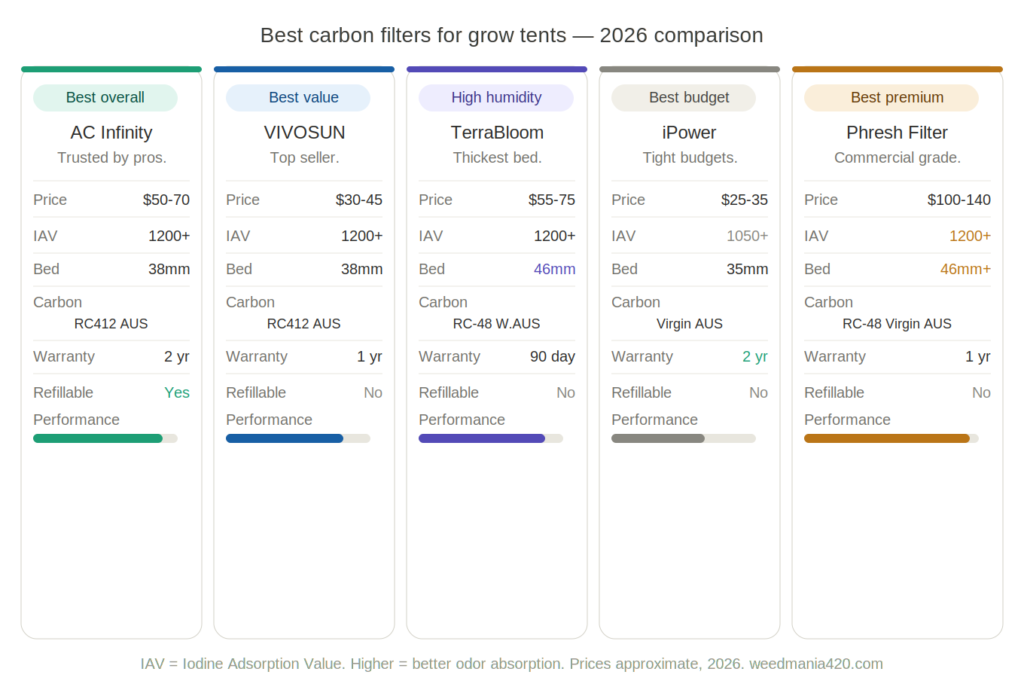
1. AC Infinity Carbon Filter — Best Overall
Price: ~$50–$70 (4-inch to 6-inch) | IAV: 1200+ | Carbon: Australian Virgin RC412
AC Infinity has quietly become the most trusted name in grow tent ventilation, and their carbon filter is a major reason why. It utilizes top quality 1200+ IAV Australian charcoal with RC412 pore sizes that provide a high adsorption rate for complete odor blockage, designed for max air current passthrough and minimal CFM loss when used with an inline duct fan.
The build quality sets it apart from budget competitors. Heavy-duty construction contains aluminum flanges and dual-sided galvanized steel mesh for durability, with versatile flanges that can also be reversed to prolong the longevity of the filter.
This filter is recommended across cannabis forums for a reason. It pairs seamlessly with AC Infinity’s own CLOUDLINE fan series, but works with any standard inline fan of the matching diameter.
The washable pre-filter cloth is a practical inclusion. Clean it every 4 to 6 weeks to maintain airflow and extend the life of the carbon bed. The 2-year warranty on the housing is one of the best in this category.
AC Infinity also now offers a refillable version — a patented design with twist-off flanges that lets you top up the carbon rather than replacing the entire unit. It includes one refill to match the filtration capacity of two standard filters while costing less, with removable twist-off flanges that support easy, tool-free refilling using the included funnel and scoop. A smart buy if you want to reduce long-term cost and waste.
Best for: Most growers. This is the default recommendation for a reason — excellent performance, solid build, fair price, and a reputable brand behind it.
Pros:
- 1200+ IAV Australian RC412 carbon
- Reversible flanges extend usable life
- Refillable version available for long-term savings
- Works with any inline fan
- Strong 2-year warranty
Cons:
- Slightly pricier than budget alternatives
- Refillable version requires more effort to maintain
👉 Check current price on Amazon (affiliate link)
2. VIVOSUN Carbon Filter — Best Value
Price: ~$30–$45 (4-inch to 6-inch) | IAV: 1200+ | Carbon: Australian Virgin Charcoal RC412
VIVOSUN is the most popular budget grow brand on the market, and their carbon filter delivers strong performance at a price that’s hard to argue with. The VIVOSUN Air Carbon Filter features premium RC412 Australian Virgin charcoal rated at 1200+ IAV, with a 38mm thick charcoal bed with high microporosity that enhances absorption effectiveness.
Designed with a dual-sided galvanized steel mesh with round holes, it maximizes airflow. The filter includes a detachable pre-filter cloth to block 99% of particles, protecting the filter media and prolonging its lifespan. The reversible flange allows flexible installation.
The 38mm carbon bed thickness is on par with filters costing twice as much, and community reports consistently rate odor elimination as solid across grows of 1 to 4 plants. If you’re setting up a first grow and want to keep costs down without sacrificing odor control, VIVOSUN is the go-to.
Best for: Budget-conscious growers and beginners. You’re getting 90% of the performance of premium filters at around half the price.
Pros:
- Excellent price-to-performance ratio
- 1200+ IAV Australian carbon
- 38mm carbon bed — solid thickness
- Reversible flange
- Widely available, fast shipping
Cons:
- Shorter lifespan than premium options (typically 12 months vs 18+)
- Pre-filter durability is average
👉 Check current price on Amazon (affiliate link)
3. TerraBloom Premium Carbon Filter — Best for High Humidity Grows
Price: ~$55–$75 (4-inch to 6-inch) | IAV: 1200+ | Carbon: RC-48 West Australian Charcoal
TerraBloom is a favorite among growers who run higher humidity levels, a common scenario in late veg and early flower. Their filter uses RC-48 charcoal from Western Australia with a 46mm carbon bed, thicker than most competitors at this price point. This carbon filter features high-quality RC-48 charcoal carbon from Western Australia. With a carbon bed of 46mm thickness inside the filter, expect this device to absorb most of the unpleasant smells and chemicals in the air for a fresh-smelling grow room.
The extra carbon depth gives it more total adsorption capacity, which translates to a longer usable life — typically 12 to 18 months even in challenging conditions. Two machine-washable pre-filters (white and black) are included in the purchase. Having two means you can always have a clean one ready while the other is drying.
TerraBloom backs it with a 90-day manufacturer’s warranty, which is shorter than AC Infinity’s 2-year, but the build quality compensates.
Best for: Growers running 60%+ humidity in their tent, or anyone who wants maximum filter lifespan before replacement.
Pros:
- Thickest carbon bed in this price range (46mm)
- Two washable pre-filters included
- Handles humidity well
- Strong odor elimination through late flower
Cons:
- Heavier than comparable filters
- 90-day warranty is shorter than AC Infinity
👉 Check current price on Amazon (affiliate link)
4. iPower Carbon Filter — Best Budget Pick
Price: ~$25–$35 (4-inch to 6-inch) | IAV: 1050+ | Carbon: Australian Virgin Charcoal
If you’re on a very tight budget and just need something reliable, iPower does the job. The iPower carbon filter is made with high-quality and durable aluminum for longevity. Its aluminum construction is more lightweight than most competitors, making it portable. The carbon filter is easy to install with an easy plug-and-play function.
The high-quality 1050+ IAV Australia Virgin Charcoal has outstanding absorbent strength that soaks up and gets rid of bad odors, and the reversible flange and base offers an extended service life of up to a year. Note the IAV is 1050+ rather than 1200+ — still functional, but a step below the others on this list. iPower offsets this with an industry-leading 2-year warranty, which is unusual at this price.
Best for: First-time growers who want to minimize initial investment while still having proper odor control.
Pros:
- Lowest price on this list
- Lightweight aluminum construction
- Reversible flange
- 2-year warranty is exceptional for the price
Cons:
- Lower IAV (1050+ vs 1200+) means slightly less adsorption
- Shorter expected carbon lifespan
👉 Check current price on Amazon (affiliate link)
5. AC Infinity Air Carbon XL 8 Filter — Best Premium Option
If budget is no concern and you want the best performing carbon filter available for a home grow, Ac Infinity is the answer. Compared to other carbon filters in the market, Air Carbon XL 8 Filter is pricier but worth every penny. One of the major reasons for its effectiveness is the RC-48 activated charcoal filter with Australian virgin carbon.
AC Infinity filters are built to commercial standards and used extensively in legal cannabis production facilities. The carbon packing density and bed thickness are best-in-class, and the housing is genuinely built to last years rather than months. Odor elimination is essentially total when properly installed.
Best for: Serious growers, multi-tent operations, or anyone in an apartment or situation where even trace odor is not acceptable.
Pros:
- Commercial-grade construction
- Best-in-class carbon density and lifespan
- Widely used by professional cultivators
- Near-total odor elimination
Cons:
- Significantly more expensive than the competition
- Overkill for casual or first-time growers
👉 Check current price on Amazon (affiliate link)
Quick Comparison Table
| Filter | Price | IAV | Bed Thickness | Best For |
|---|---|---|---|---|
| AC Infinity | ~$50–$70 | 1200+ | 38mm | Best overall |
| VIVOSUN | ~$30–$45 | 1200+ | 38mm | Best value |
| TerraBloom | ~$55–$75 | 1200+ | 46mm | High humidity |
| iPower | ~$25–$35 | 1050+ | 35mm | Best budget |
| Phresh | ~$100–$140 | 1200+ | 46mm+ | Best premium |
How to Set Up Your Carbon Filter Correctly
Even the best filter will leak odor if it’s installed incorrectly. Here’s the setup that works:
The standard setup: Place the carbon filter inside the tent at the top, connected directly to your inline fan via a short section of ducting. The fan then exhausts air out through the tent’s ventilation port. Hot air rises naturally, so exhausting from the top removes the hottest, most odor-laden air first.
The most common setup is a carbon filter at the top of the tent attached to the inline fan via duct, then ducted outside the tent through a port. The filter goes inside the tent; the fan can be inside or outside.
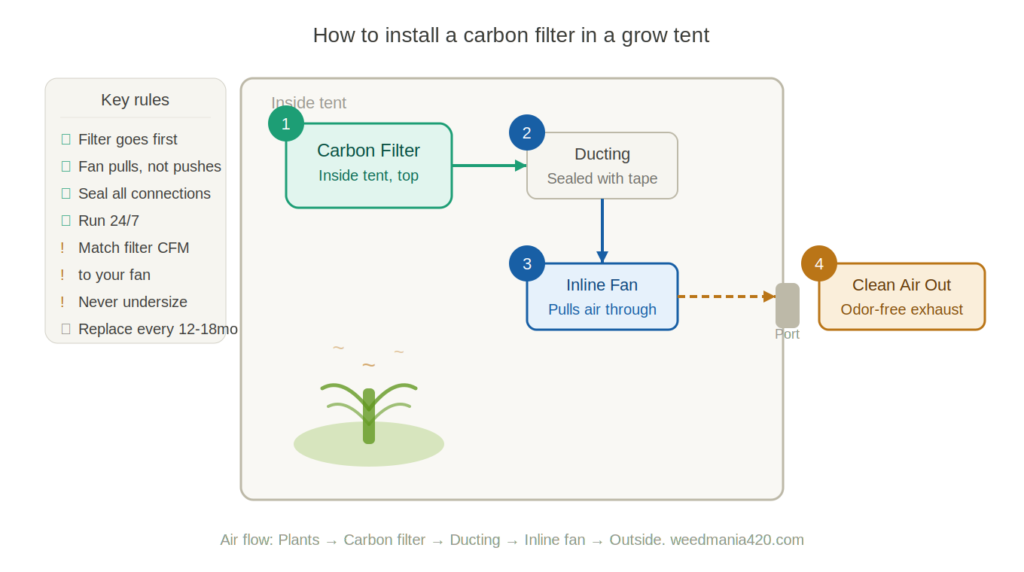
The correct airflow direction: Air should be pulled through the filter by the fan, not pushed. This means: air enters the filter from the outside, passes through the carbon, exits into the ducting, and is then pushed out by the fan. Filter first, fan second.
Seal everything: Odor is sneaky. Use aluminum foil tape on all duct connections and around the fan housing. Any gap will let odor escape. Make sure all the air being pulled from the room is going through the filter. Ensure that everything is properly sealed. Air should only enter the exhaust system through the carbon filter and should go straight outside.
Run it continuously: Run exhaust fans 24/7 or the smell will sneak out through the fabric of the tent. Even during lights-off. Odor builds up in the tent air regardless of light cycle, especially during peak flower.
Keep the pre-filter clean: Wash the pre-filter sleeve every 4 to 6 weeks with warm water and mild soap. A clogged pre-filter restricts airflow, which reduces the volume of air being scrubbed per minute and lets odor build up in the tent.
When to Replace Your Carbon Filter
Quality carbon filters last 1 to 2 years with normal use. Signs it needs replacing include persistent odor despite the filter running, visible moisture damage to the carbon, or the filter has been in use for 18 months or more in a humid environment.
A few other signs to watch for: the filter feels noticeably lighter than when new (carbon has settled or compressed), or airflow seems lower than usual even with a clean pre-filter (carbon bed may be blocking rather than filtering).
Budget around $30 to $70 per year for filter replacement. Treat it like a running cost of indoor growing, like nutrients or electricity.
Common Mistakes to Avoid
Sizing down to save money. An undersized filter is worse than no filter as it gives false confidence while odor leaks around it. Always meet or exceed your fan’s CFM.
Forgetting about the tent opening. Every time you open the tent during flower, odor escapes. Work quickly, close it promptly, and consider keeping a small room air purifier outside the tent running continuously to catch any leakage.
Running the fan on low during lights-off. Even at minimum speed, your fan needs to cycle all the tent air through the filter continuously. Many AC Infinity fans can be programmed to maintain a minimum speed regardless of temperature. Use that feature.
Ignoring humidity. High humidity reduces how well carbon adsorbs odor molecules. Keep your tent humidity below 65% during flower, not just for bud quality, but also to extend filter life.
Final Verdict
For most growers, the AC Infinity carbon filter is the right call. It’s trusted, well-built, and available in a refillable version that cuts long-term costs. If you’re watching every dollar, the VIVOSUN delivers solid performance at roughly half the price. Running high humidity? Go with the TerraBloom for its thicker carbon bed.
A carbon filter is the cheapest insurance policy in a grow tent setup. Buy the right one, install it correctly, and it quietly does its job for the entire grow cycle.