

Quick Answer: Zip yourself inside your tent with the grow light off and wait 5 minutes for your eyes to adjust. Any light you see coming through is a leak that needs fixing. Run this check at setup, after any equipment changes, and at the flip to 12/12.
Light leaks do not announce themselves. You will not know you have one until your plants start herming, re-vegging, or flowering weeks behind schedule. By then the damage is done.
One foot candle of light — roughly the brightness of a single candle at one foot away — is enough to throw cannabis plants from the flowering phase back into vegetative growth. That is barely visible to the naked eye. It is also completely fixable in under 10 minutes if you catch it early.
This guide covers exactly how to find every leak in your tent, where they typically hide, how serious each type is, and how to seal them for good.
Disclosure: This post contains affiliate links. Purchases through the links may earn us a small commission at no extra cost to you. We only recommend products we have genuinely researched and believe in.
Table of Contents
Why Light Leaks Matter (and When They Do Not)
Light leaks only affect photoperiod plants during the 12-hour dark period. The mechanics are straightforward: cannabis growth is controlled by its photoperiod, and the amount of light a plant receives dictates whether it is in vegetative or flowering mode.
Cannabis produces a hormone called phytochrome that is sensitive to light. When light leaks are present, phytochrome imbalances occur and can cause the plant to revert to the vegetative period or, at worst, hermaphrodite — leaving you with decreased yields or seeded buds.
Two things that do not need fixing:
Autoflowers. They flower based on age, not light schedule. A light leak in an autoflower tent is a non-issue for flowering. Seal it anyway for cleanliness, but do not stress about it affecting your harvest.
Veg-stage photoperiods. Plants in veg run on 18/6 or even 24/0. Light entering during the 6-hour dark period of a veg plant is unlikely to cause problems. The critical window is after you flip to 12/12.
A sealed environment is not just about light. Any gap that lets light in also lets pests in and lets CO2 out before it passes through your carbon filter. Fixing light leaks improves your whole environment, not just your photoperiod.
The Darkness Test — How to Find Every Leak
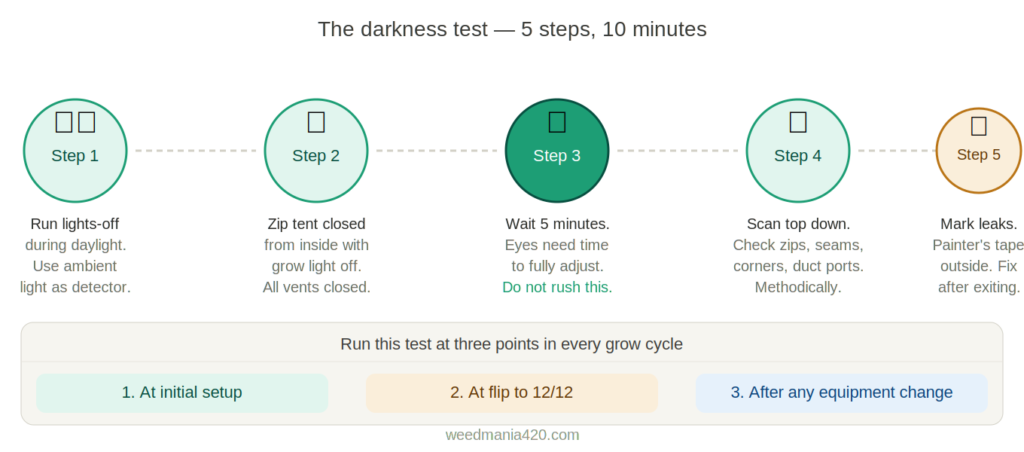
This takes 10 minutes and costs nothing.
Step 1: Run lights-off during daylight hours for this test. Daytime ambient light from windows and rooms is your leak detector. If you normally run lights-off at night, temporarily shift the schedule one day or pull the blinds and let ambient room light do the work.
Step 2: Turn the grow light off and zip the tent fully closed from inside.
Step 3: Sit still in the dark for 5 minutes. Your eyes need time to fully adjust to the darkness before you can spot subtle light coming through seams, pinholes, and vent ports. Do not rush this. The first 60 seconds your eyes are still calibrating and you will miss the small leaks.
Step 4: Scan methodically. Start at the top and work down. Check zips, corners, and joins specifically — these are the highest-risk areas on any tent.
Step 5: Mark every leak. Stick a piece of painter’s tape on the outside of each leak location as you find it. Do not try to fix them while inside the tent — mark first, fix after.
Where Light Leaks Hide
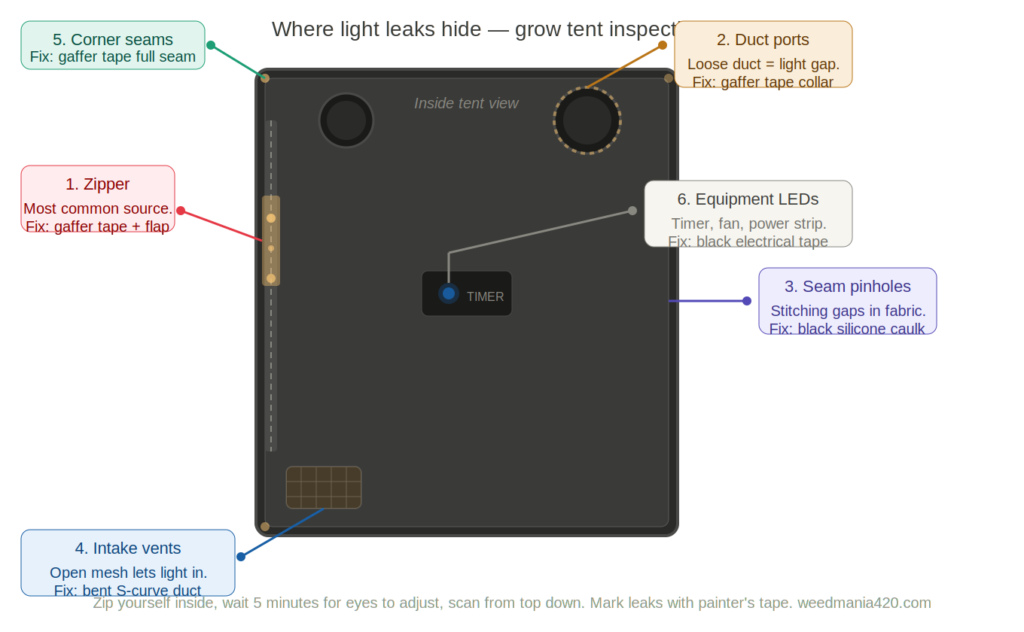
Zippers
The most common source. Budget tents use single-layer zippers with no overlap. Quality tents add an internal flap that backs the zipper channel. Even expensive tents show pin-prick light at velcro flaps and zipper areas when inspected from inside in darkness. This is normal at low levels but worth sealing in flower.
Fix: Run a strip of black gaffer tape along the outside of the zipper channel. For the main door zip, drape a piece of blackout fabric or thick dark canvas over the entire zip panel during dark periods.
Seams and Stitching
New tents commonly show pinhole light leaks at sewn seams — tiny gaps where thread passes through the fabric. These are almost universal on budget tents and appear on premium ones too.
Fix: Apply a thin smear of black silicone caulk along the outside of the seam while the light is on inside the tent, so you can see exactly where the light passes through. Leave the door open until the silicone cures fully — 3 to 4 hours minimum. Gorilla tape also works and is faster.
Duct Ports and Fan Openings
Duct ports for inline fans and exhaust ducting are circular cutouts in the tent fabric. Any port that is not fully occupied by ducting leaks light. Ports with loose-fitting ducting or gaps around the collar are the second most common leak source after zippers.
Fix: Wrap the duct connection with black gaffer tape until no gap remains between the ducting and the port collar. For unused ports, stuff them with a rolled piece of black fabric or use the drawstring cinch that most quality tents include.
Intake Vents
Passive intake vents at the base of the tent are designed to allow airflow, not block light. Most have a simple mesh screen that does nothing to stop light.
Fix: Route intake ducting in a bent S-curve so no direct line of sight exists from the vent to the plant canopy. Bending intake duct prevents light reaching plants while still allowing sufficient airflow. Alternatively, use an active intake fan with ducting and seal the vent collar the same way as exhaust ports.
Corners and Floor Seams
Where fabric panels meet at the tent’s corners and base, thin seams can develop small gaps — especially on older tents where the material has stretched slightly over time. If the tent walls are being stretched, light can penetrate at the seam lines.
Fix: Black gaffer tape on the outside. Run it along the full corner seam rather than spot-patching individual pinholes.
Equipment LEDs
Any electrical equipment inside the tent that emits light — power strips, fan LEDs, timer displays — contributes to the internal light environment during dark periods. These do not cause the same hermaphrodite risk as external light entering the tent, but they add unnecessary light during dark hours.
Fix: Cover every indicator LED on timers, fans, and power strips with black electrical tape. Takes 2 minutes and eliminates the issue entirely.
How Serious Is Each Type of Leak?
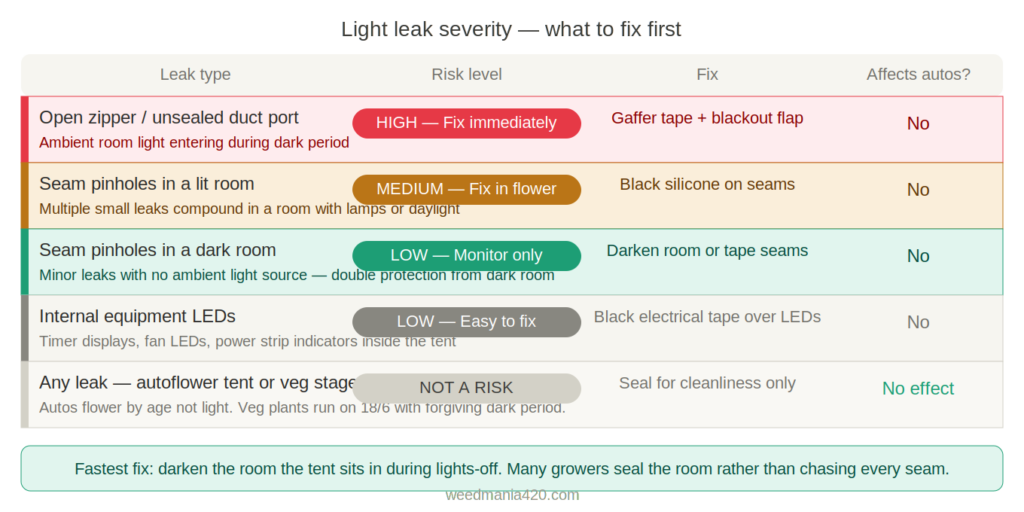
Not all leaks carry equal risk. Here is a practical severity ranking:
High risk: Direct ambient light entering through large gaps, unsealed door zips, or open duct ports during a bright daytime lights-off period. This level of light intrusion during the 12-hour dark period will cause re-vegging and potentially hermaphroditism with most genetics.
Medium risk: Pinhole seam leaks and minor zip gaps in a room that has its own light source (a lamp, hallway light through a door gap). The combined effect of multiple small leaks in a lit room adds up.
Low risk: Pinhole seam leaks in a completely dark room. Placing your tent in a room that is itself dark during lights-off provides a double layer of protection, making minor tent leaks inconsequential in practice. Many experienced growers rely on this approach rather than sealing every pinhole.
Not a risk: Internal equipment LEDs, autoflower tents, veg-stage plants.
The Fastest Fix for Any Leak: The Dark Room Strategy
Before spending time taping every seam, ask whether the room your tent sits in can be darkened during the dark period. Pulling blinds, blocking door gaps with a door snake, and keeping room lights off during the 12-hour dark window eliminates the risk from even a moderately leaky tent. Many experienced growers seal the room rather than the tent, finding it more reliable and less time-consuming than chasing every tent seam.
This works best when the dark period runs at night, when ambient outdoor light is minimal. If you run lights-off during the day, darkening the room becomes more critical and worth doing regardless of how well-sealed your tent is.
Sealing Materials: What Works
Black gaffer tape is the standard fix. Sticks reliably to fabric, peels cleanly without residue, and is completely opaque. Gorilla tape also works but leaves residue on fabric if removed.
Black silicone caulk is best for seam pinholes. Apply from outside while the light is on inside so you can see exactly where to target. Cures in 3 to 4 hours and remains flexible so it does not crack when the tent fabric moves.
Blackout fabric draped over the main door zip adds a second layer during dark periods without permanent modification. 1 metre of heavy blackout fabric from any fabric shop costs under $5 and eliminates the most common leak source entirely.
Reflective sheeting on room windows. Curtains alone do not block light reliably. Reflective or blackout window film keeps natural light out of the room during the day and prevents grow light from disturbing anyone outside the room at night.
Checking for Leaks the Other Direction
Leaks work both ways. Grow light escaping from the tent during lights-off can disturb anyone sleeping in the same room, and visible light from a window at night can draw unwanted attention.
To check for outgoing leaks, stand outside the tent in a darkened room while the grow light is running. Any light you see escaping through seams, ports, or zips needs the same treatment as an incoming leak.
Maintenance Schedule
Check for light leaks at these three points in every grow cycle:
At initial setup, before any plants go in. This is the easiest time to fix problems.
At the flip to 12/12 for photoperiod plants. Any leak you have been ignoring in veg becomes critical from this point forward.
After any equipment change — new fan, new ducting, repositioned light. Moving equipment inside the tent frequently shifts duct connections and can open gaps that were previously sealed.
A 10-minute darkness test costs nothing. Re-vegging a plant costs 3 to 4 weeks of growth and a harvest that arrives a month late.
FAQ
Do light leaks affect autoflowers? No. Autoflowers flower based on age, not light schedule. A light leak in an autoflower tent will not affect flowering or trigger hermaphroditism.
What is the fastest way to find a light leak? Zip yourself inside the tent with the grow light off, wait 5 minutes for your eyes to adjust, then scan every seam, zip, and port. Any visible light is a leak.
Can a light leak cause hermaphroditism? Yes, but it requires consistent exposure during the dark period rather than a single brief instance. Severe leaks in brightly lit rooms over multiple nights are the real risk, not a single brief exposure.
How dark does a tent need to be during lights-off? Completely dark at plant canopy level during the 12-hour dark period. Use a light meter app on your smartphone at canopy height if you want to verify. Any reading above zero is worth addressing.
Is it better to seal the tent or seal the room? Both work. Sealing the room is faster and often more reliable, especially if your tent has multiple minor seam leaks. Sealing the tent is better if the room itself gets a lot of ambient light during the day.