
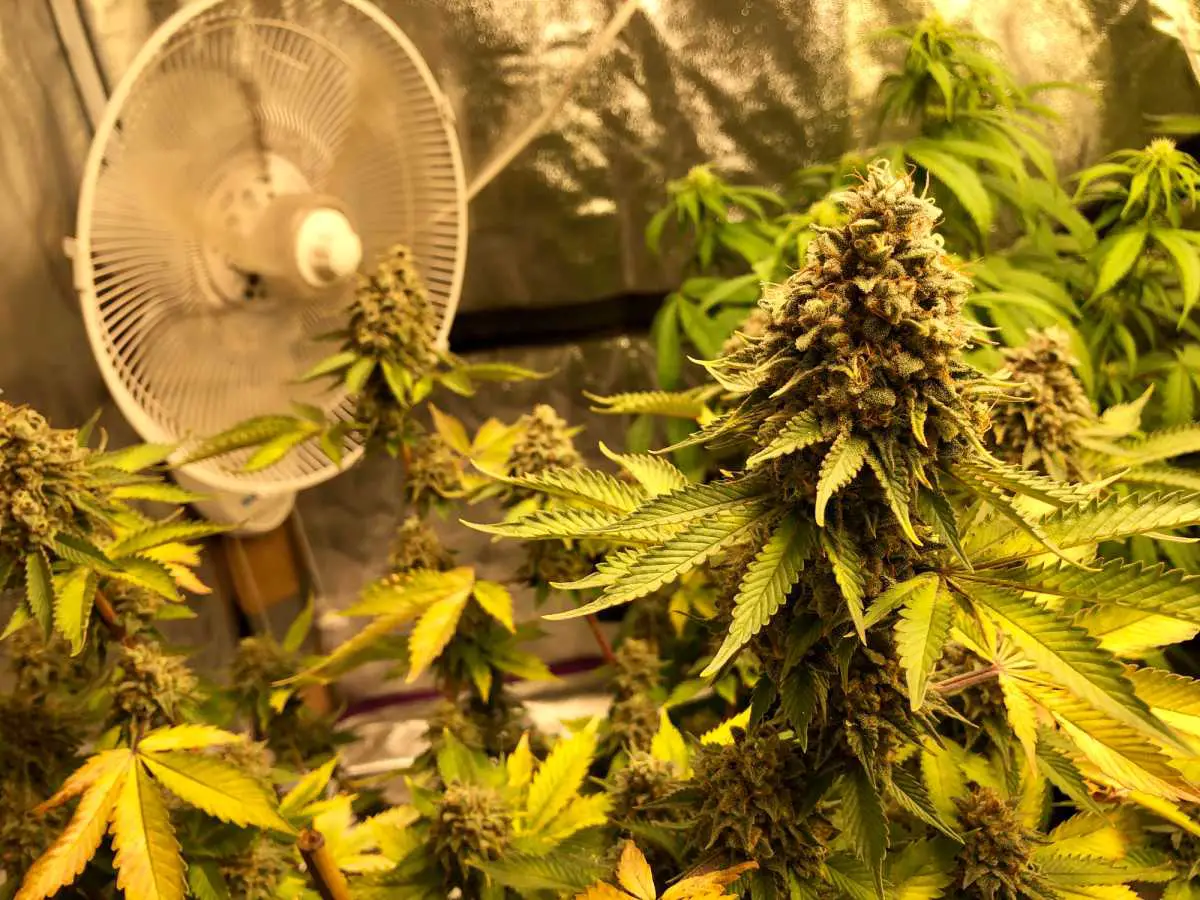
Quick Answer: The AC Infinity CLOUDRAY S6 is the best oscillating clip fan for most grow tents — EC motor, 10 speeds, 10 oscillation levels, IP54 weatherproof rating, and full integration with the AC Infinity controller ecosystem. For budget grows, the VIVOSUN AeroWave A6 delivers solid circulation at roughly half the price. For large rooms and 4×8 and above, the Hurricane Supreme 16-inch pedestal fan moves enough air to cover the full footprint.
An inline fan handles air exchange. An oscillating fan handles air circulation. They are not the same thing, and one does not replace the other.
Your inline fan exhausts stale, hot air out of the tent and pulls fresh air in. The oscillating fan keeps that fresh air moving across the canopy continuously. Without that internal movement, you get pockets of stagnant air where humidity concentrates, CO2 depletes near the leaf surface, and heat builds under the light. Cannabis plants pollinate with wind rather than bees, so keeping a slight breeze across the tops of all plants helps induce strong bud growth. Beyond pollination mechanics, that same gentle movement strengthens stems as the plant braces against resistance, a process called thigmomorphogenesis, which produces noticeably thicker, sturdier plants compared to those grown in still air.
The key word is gentle. The goal is leaves that vibrate slightly, not flap. Too much direct airflow desiccates tips, stresses roots, and creates wind burn that looks identical to nutrient problems and gets treated as such. Position fans to create indirect movement across the canopy, not a direct beam at leaves from 6 inches away.
This guide covers every fan type suited to grow tents, the best options at each price point, and exactly how to position them for maximum effect.
Disclosure: WeedMania420 participates in the Amazon Associates Program. Purchases through our links may earn us a small commission at no extra cost to you. We only recommend products we have genuinely researched and believe in.
Table of Contents
Clip Fan vs Oscillating Pedestal vs Tower Fan: Which Type Do You Need?
Clip-on fans are generally small products used in small growing spaces. They clip onto the support structure of the grow tent poles and generate less power than larger oscillating fans, but provide airflow to hard-to-reach and small areas. For tents up to 4×4, a quality 6-inch clip fan on each side of the tent is sufficient and leaves maximum growing space intact.
Oscillating fans are efficient products that direct air movement across the grow tent by oscillating in multiple directions over a short period of time. They come in many sizes and styles, but their main use is to provide air circulation throughout the plant canopy. Pedestal oscillating fans suit 4×4 and larger tents where a clip fan simply cannot generate enough air movement to cover the full footprint.
Tower fans are a legitimate alternative for longer tents. A tower fan in a 2×2 running on full all the time can work well continuously for 6 months without issues. The tower shape covers all plants effectively. The vertical profile takes up minimal floor space, which matters in compact setups where every inch counts.
Size guide:
- 2×2 to 3×3 tent: one 4-inch or 6-inch clip fan
- 4×4 tent: two 6-inch clip fans or one 10-inch oscillating pedestal
- 4×8 tent: two 6-inch clip fans plus one pedestal fan, or one 16-inch pedestal
- 5×5 and above: two pedestal fans or multiple clip fans at canopy and floor level
What to Look for Before Buying
EC vs AC motor. EC (electronically commutated) motors offer variable speed control from 0 to 100%, run quieter, and consume less electricity than AC motors. EC motor clip fans with carbon steel gears and dual-ball bearings for omnidirectional mounting maximize efficiency and control, ensuring strong, consistent airflow. If you are pairing a clip fan with a VPD controller, you need an EC motor fan for the controller to modulate speed based on environmental triggers. AC motor fans only receive on/off commands regardless of the controller.
Oscillation range. Look for an oscillation range of 70 to 180 degrees for full coverage. A fan that only sweeps 45 degrees creates uneven airflow, leaving corners stagnant. Fans with multiple oscillation levels let you narrow coverage to a specific zone or expand to full sweep depending on your tent layout and canopy stage.
IP rating. Grow tents are humid environments, particularly in late veg and early flower when transpiration peaks. An IP54 or higher rating protects the motor from water ingress. Budget fans with no IP rating fail faster in high-humidity environments and pose a minor electrical risk near water sources.
Noise. Quiet operation at 50 dB or below suits nighttime operation and grow-room stealth. EC motor fans run significantly quieter than AC motor fans at equivalent airflow levels. If your tent is in a bedroom or shared space, noise is a practical purchasing criterion, not just a comfort preference.
Clamp strength. A clip fan that works loose mid-grow and falls onto plants can cause serious damage, particularly during flowering when buds are fragile. Metal clamps with vise-grip designs are significantly more secure than plastic clamps. A space-saving metal clamp with a vise-grip-style design ensures a dependable hold on tent poles.
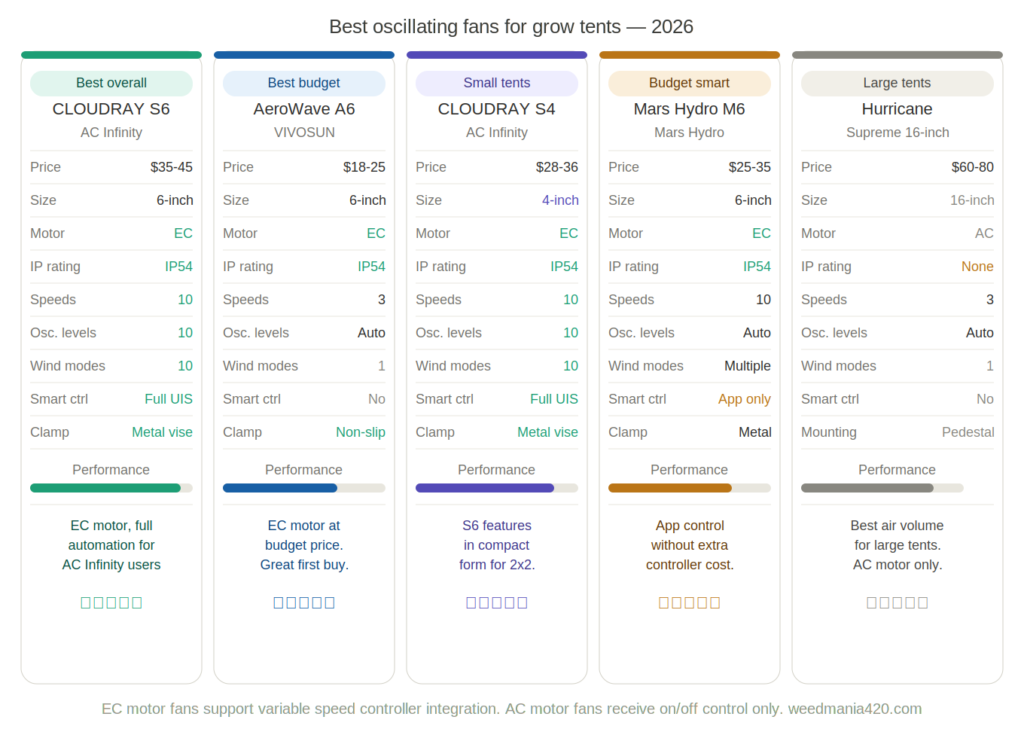
The Best Oscillating Fans for Grow Tents in 2026
1. AC Infinity CLOUDRAY S6 — Best Overall Clip Fan
Price: ~$35-45 (single), ~$55-65 (2-pack) | Size: 6-inch | Motor: EC | IP rating: IP54
The CLOUDRAY S6 is the most technically capable clip fan available for home cannabis growers in 2026. It features 10 oscillation ranges that can focus on targeted areas or achieve wide coverage while avoiding obstacles, 10 speeds, and 10 dynamic wind modes to simulate outdoor airflow for optimal plant growth.
The EC motor is specially designed in size and construction to lengthen oscillation lifespan, using a brushless motor design with resilient carbon steel gears and dual-ball bearings for omnidirectional mounting. This is the construction that separates the CLOUDRAY from budget clip fans, where the oscillation mechanism is typically the first component to fail.
The 10 dynamic wind modes simulate outdoor gusting patterns rather than constant steady airflow, which strengthens stems more effectively than a fixed-speed fan and reduces the risk of localised wind burn from continuous directional exposure. It links with UIS controllers for WiFi app control and access to climate triggers, timers, and advance automation. If you are already using an AC Infinity Controller 69 Pro, the CLOUDRAY S6 integrates fully for automatic speed adjustment based on VPD and temperature triggers.
IP54 weatherproofing handles the humidity levels of late flower without motor degradation. The metal clamp holds securely on standard tent poles in any orientation, including inverted mounting for under-canopy airflow.
Best for: Growers in the AC Infinity ecosystem, anyone wanting EC motor precision and controller integration, and 2×2 to 4×4 tents.
Pros:
- EC motor with 10 speeds, 10 oscillation levels, 10 wind modes
- IP54 weatherproof rating handles high-humidity flower periods
- Metal vise-grip clamp is significantly more secure than plastic alternatives
- Full UIS controller integration for automated speed adjustment
- Available as a cost-effective 2-pack
Cons:
- Full automation requires AC Infinity controller (sold separately)
- Higher price than budget clip fans
👉 Check current price on Amazon.
2. VIVOSUN AeroWave A6 — Best Budget Clip Fan
Price: ~$18-25 (single), ~$28-35 (2-pack) | Size: 6-inch | Motor: EC | IP rating: IP54
The VIVOSUN AeroWave A6 brings EC motor performance to the budget tier. It features auto oscillation, a secure non-slip clamp, strong air circulation, and low noise for hydroponic ventilation. At roughly half the price of the CLOUDRAY S6, it delivers the core features that matter most: EC motor, IP54 protection, and solid oscillation coverage.
The non-slip clamp is VIVOSUN’s improved design over earlier models, which had a reputation for loosening over time on smooth tent poles. The current AeroWave A6 clamp holds reliably through the grow cycle without requiring periodic retightening. The IP54 rating matches the CLOUDRAY S6 for weather resistance.
The main trade-off is the reduced customisation range compared to AC Infinity. The AeroWave A6 offers fewer speed settings and a more limited oscillation range, and does not integrate with controller ecosystems for automated speed adjustment. For growers managing their tent manually rather than through a smart controller, those limitations are irrelevant.
Best for: Budget-conscious growers, first-time setups, and anyone not using a smart controller system.
Pros:
- EC motor at budget price point
- IP54 weatherproofing
- Non-slip clamp design holds securely on tent poles
- Available in 2-pack for significant cost saving
- Quiet enough for living space tents
Cons:
- Fewer speed and oscillation settings than the CLOUDRAY S6
- No smart controller integration
👉 Check current price on Amazon.
3. AC Infinity CLOUDRAY S4 — Best for Small Tents
Price: ~$28-36 | Size: 4-inch | Motor: EC | IP rating: IP54
The CLOUDRAY S4 is the 4-inch variant of the S6, purpose-built for 2×2 tents and tight growing spaces where a 6-inch fan would dominate the available pole positions. It utilises a small form factor and high static pressure design that produces superior circulation in tight spaces, delivering greater wind velocity when compared to larger fans.
The miniaturised EC motor retains the same carbon steel gears and dual-ball bearings of the S6 in a more compact build. Ten oscillation levels deliver focused circulation to specific spots or offer the widest reach possible while avoiding obstacles, with ten speeds and ten dynamic wind modes to simulate outdoor airflow for optimal plant growth.
For a 2×2 grow tent setup, one CLOUDRAY S4 mounted at mid-height on a corner pole is sufficient for most grows. Two S4s on opposite corners gives redundancy and more even canopy coverage.
Best for: 2×2 tents, micro grows, tight spaces where a 6-inch fan occupies too much pole real estate.
Pros:
- Small form factor without sacrificing EC motor quality
- High static pressure produces strong airflow from a compact unit
- Full UIS controller integration
- Same IP54 protection as the S6
Cons:
- Lower total airflow volume than the 6-inch S6
- Costs almost as much as the S6 for less coverage
👉 Check current price on Amazon.
4. Mars Hydro M6 — Best Smart-Connected Budget Fan
Price: ~$25-35 (single), ~$40-50 (2-pack) | Size: 6-inch | Motor: EC | IP rating: IP54
The Mars Hydro M6 is a powerful oscillating clip fan with low noise for hydroponic plants and ventilation circulation, with convenient app and WiFi control. It sits between the VIVOSUN AeroWave and the AC Infinity CLOUDRAY in both price and capability, offering smart app control without the full AC Infinity ecosystem price premium.
The app integration is the differentiating feature at this price point. You can set timers, adjust speed remotely, and monitor the fan without purchasing a separate controller. For growers who want basic automation without committing to the AC Infinity or VIVOSUN smart ecosystems, the M6 offers an accessible middle ground.
The 2-pack pricing is particularly competitive. Two M6s for around $45 covers a 4×4 tent with app-connected fans at a total cost below a single CLOUDRAY S6.
Best for: Growers who want app-connected airflow without the AC Infinity price point, and 4×4 tent operators who want two smart fans at a reasonable combined cost.
Pros:
- App and WiFi control at a mid-range price
- EC motor with IP54 rating
- Competitive 2-pack pricing
- Works independently without additional controller hardware
Cons:
- Mars Hydro app is less polished than AC Infinity’s offering
- Fewer speed and oscillation settings than the CLOUDRAY S6
👉 Check current price on Amazon.
5. Hurricane Supreme 16-Inch Pedestal Fan — Best for Large Tents and Grow Rooms
Price: ~$60-80 | Size: 16-inch | Motor: AC | IP rating: None
The Hurricane Supreme is ranked as the best oscillating fan for large grow tent applications because of its 16-inch size and powerful 3-speed design that ensures cannabis crops receive the air they need. For 4×8 tents, 5×5 tents, and open grow rooms, clip fans alone cannot generate the air volume needed for a full canopy. A 16-inch pedestal fan positioned at the perimeter of a large tent moves enough air to reach every corner.
The Hurricane Supreme operates on an AC motor, which means it does not offer variable speed integration with smart controllers. The three fixed speed settings handle the range from seedling through late flower with manual adjustment. The stable base and 75-degree tilt range let you direct airflow precisely without relying on tent pole positions.
Note that this fan is not IP-rated for humidity resistance. In high-humidity environments during late veg and early flower, position it to draw from below the canopy rather than above, which reduces direct water exposure to the motor housing. For dedicated grow rooms without a tent enclosure, a pedestal fan is often the most practical air circulation solution.
Best for: 4×8 tents and larger, open grow rooms, and any setup where clip fans cannot generate sufficient air volume.
Pros:
- Moves significantly more air than clip fans at comparable cost
- Three speed settings cover all growth stages
- Stable base, 75-degree tilt for directional control
- Well-established track record in the cannabis community
Cons:
- AC motor only, no variable speed controller integration
- No IP rating, less suitable for high-humidity enclosed spaces
- Takes up floor space in the tent
👉 Check current price on Amazon.
Quick Comparison
| Fan | Price | Size | Motor | IP Rating | Smart Control | Best For |
| AC Infinity CLOUDRAY S6 | ~$35-45 | 6-inch | EC | IP54 | Full UIS | Most growers |
| VIVOSUN AeroWave A6 | ~$18-25 | 6-inch | EC | IP54 | No | Budget grows |
| AC Infinity CLOUDRAY S4 | ~$28-36 | 4-inch | EC | IP54 | Full UIS | 2×2 tents |
| Mars Hydro M6 | ~$25-35 | 6-inch | EC | IP54 | App only | Mid-budget smart |
| Hurricane Supreme 16″ | ~$60-80 | 16-inch | AC | None | No | Large tents |
How to Position Your Clip Fan
Placement matters more than most growers realise. The common mistake is mounting the fan at canopy height aimed directly at the plants. That creates wind burn on whatever sits in the direct stream while leaving areas outside the beam stagnant.
Mount the fan slightly above canopy level, angled downward at 15 to 20 degrees, pointed toward the centre of the tent rather than directly at individual plants. This creates a diffuse movement across the full canopy rather than a direct stream. Oscillation spreads the airflow further, but the starting position still matters.
For a 4×4 tent with two clip fans, mount them on opposite corner poles, angled inward at each other. The crossing airflow patterns create turbulence throughout the canopy without concentrating on any single area. This is more effective than two fans pointed in the same direction.
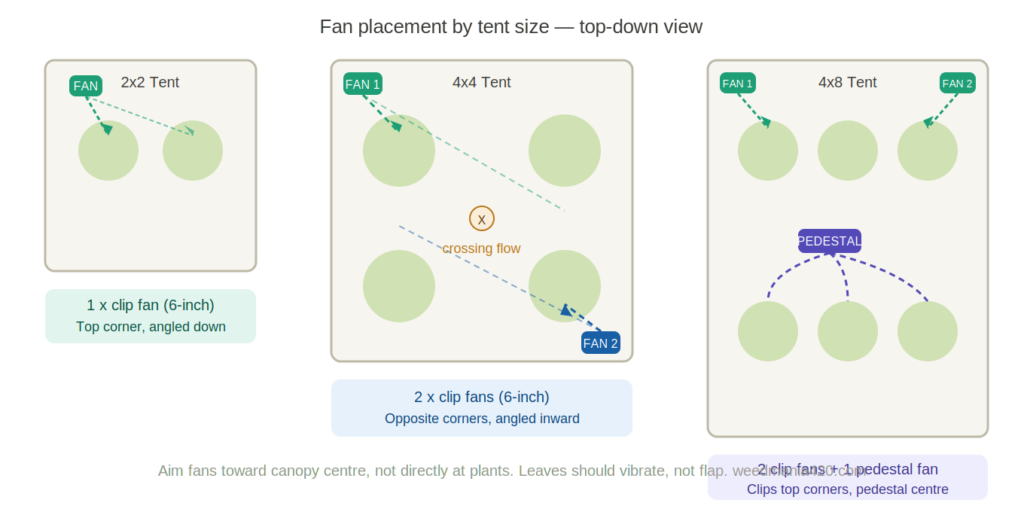
Do not place the fan too close to plants — just keep it so leaves are vibrating, not flapping. If leaves are visibly bending under airflow, pull back the speed setting or reposition the fan further from the canopy.
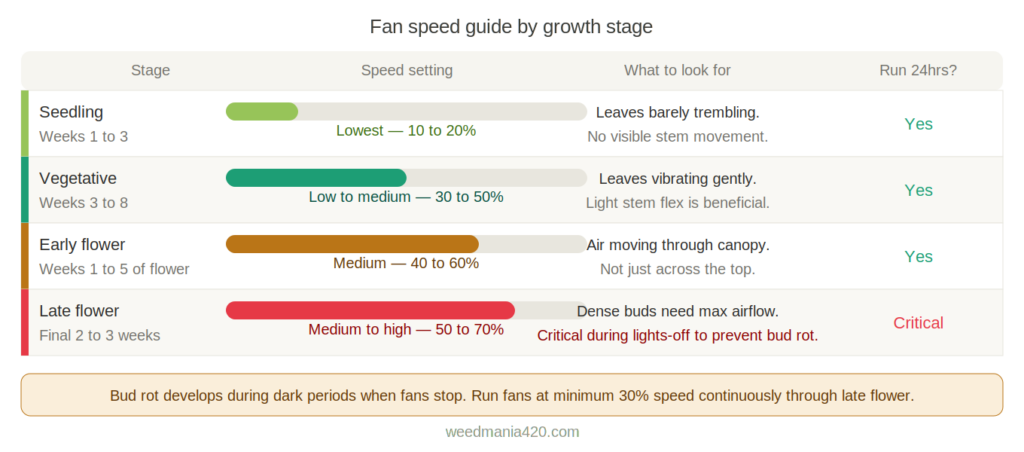
Fan Speed by Growth Stage
Seedlings (weeks 1 to 3). Lowest speed setting available. Seedlings have no established root structure to anchor them against airflow, and gentle indirect movement is all that is needed to strengthen stems and prevent surface humidity from pooling on leaves.
Vegetative stage. Low to medium speed. As the canopy develops, increase airflow progressively. The goal is to see leaves trembling gently rather than sitting still. Some stem flex is beneficial at this stage as it drives thicker cell wall development.
Flowering. Medium speed. Dense canopies trap humidity between buds in still air, creating ideal conditions for botrytis. Airflow that moves through the canopy rather than across the top of it is the key distinction. Position one fan at canopy level and one at sub-canopy level if possible to ensure humidity does not concentrate between lower bud sites.
Late flower. Maintain medium speed and consider running fans during the dark period as well. Humidity typically rises during lights-off as transpiration slows but plants continue releasing moisture. Bud rot almost always develops during the dark period when airflow stops, not during lights-on. Pairing fan management with a VPD controller that continues running fans at a minimum speed during dark periods eliminates this risk.
Air Circulation vs Air Exchange: Not the Same Thing
This distinction is worth repeating clearly. An oscillating fan circulates air within the tent. An inline fan exchanges air between the tent and the outside. You need both.
Your inline fan and carbon filter setup handles the ventilation side: pulling fresh CO2-rich air in, exhausting hot stale air out, and running your odour filtration. Your oscillating clip fan handles internal circulation: keeping that fresh air moving continuously across every part of the canopy once it enters the tent.
A correctly sized inline fan with no oscillating fan produces an environment where fresh air enters and exits without ever reaching the centre of the canopy. An oscillating fan with no inline fan circulates the same stagnant air in an endless loop. Both are necessary and neither replaces the other. See the grow tent ventilation calculator for the inline fan side of this equation.
FAQ
How many clip fans do I need in a 4×4 tent? Two 6-inch clip fans mounted on opposite corner poles, aimed toward the centre. This creates crossing airflow patterns that circulate air through the canopy without wind-burning any single area.
Can I run my clip fan 24 hours a day? Yes, and for most of the grow you should. EC motor fans like the CLOUDRAY S6 are designed for continuous operation. Running fans during lights-off is particularly important in late flower to prevent humidity spikes that cause bud rot.
What is the difference between a clip fan and an inline fan? An inline fan exhausts air in and out of the tent through ducting. A clip fan circulates air inside the tent. You need both for a complete ventilation setup. See our full 2×2 grow tent setup guide for how they work together.
Do I need an oscillating fan if I already have an inline fan? Yes. An inline fan does not circulate air within the tent, it only exchanges it. Without internal circulation, humidity and CO2 depletion concentrate in specific zones around the canopy regardless of how well-sized your inline fan is.
What does IP54 mean on a clip fan? IP54 means the fan is protected against dust ingress and water splashing from any direction. For grow tent use, IP54 handles condensation and high-humidity environments without motor damage. It does not mean fully waterproof.